25 September 2021

Flash Gordon Inspiration: The Comic Strips 1941-1944

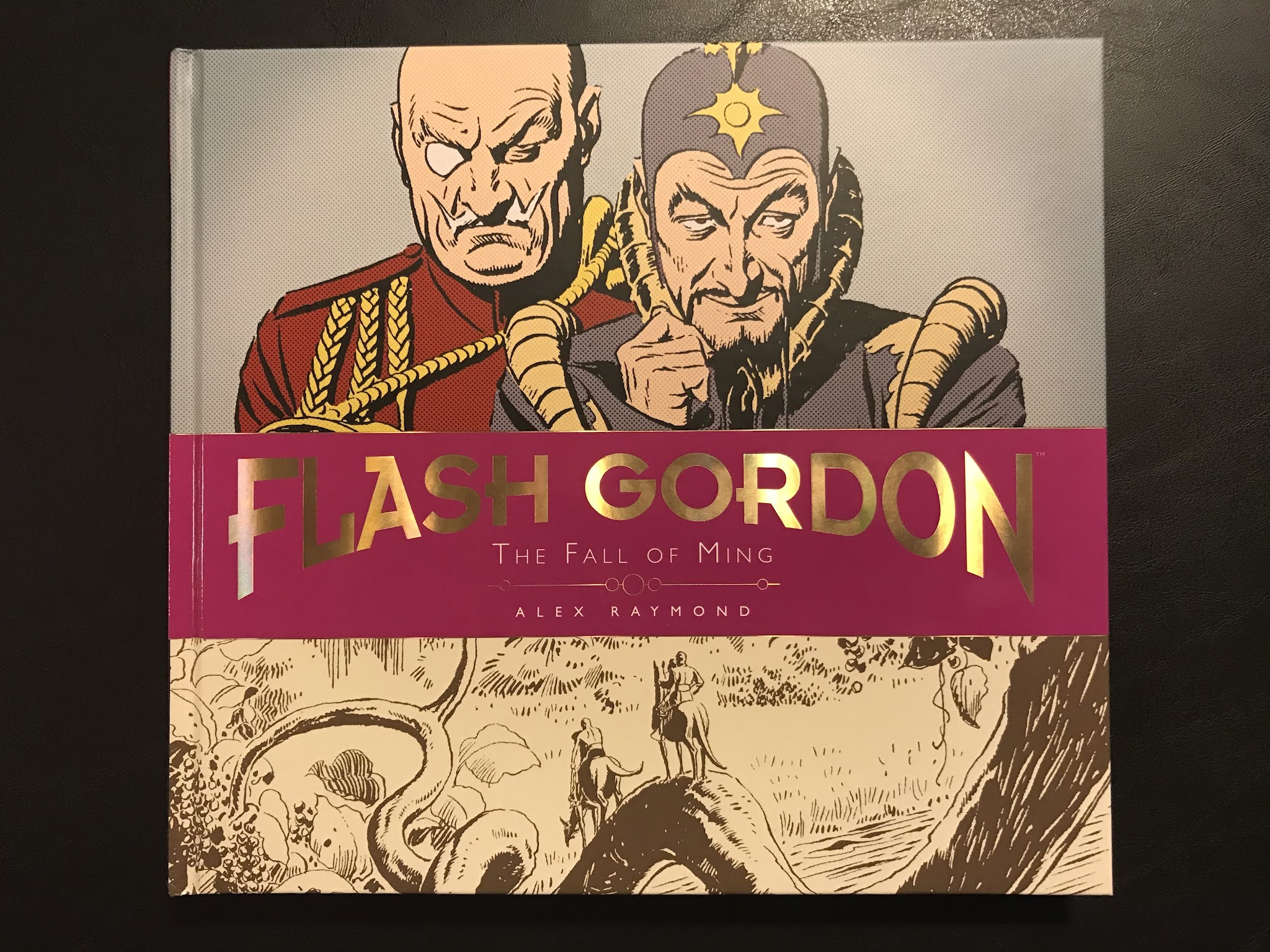
My copy of Flash Gordon: The Fall of Ming (Sundays 1941-1944). The cover depicts Warden Terro and Ming the Merciless.

Flash Gordon: The Fall of Ming (Sundays 1941–1944) is the third volume in the collected Flash Gordon comic strips by Alex Raymond and Don Moore, and the final volume containing Raymond's art. Raymond enlisted in the U.S. Marine Corps in 1944, and Austin Briggs, who was the artist of the Flash Gordon daily comic strips from 1940–1944, became the new artist of the Sunday comic strips immediately following Raymond's final strip, which was printed 7 May 1944. Later, upon his return from the war, Raymond devoted himself to another comic strip of his own creation, Rip Kirby.

SPOILER ALERT

The early 1940s mark a period of great change for this comic strip. We witness the fall of Emperor Ming and the establishment of a union of democratic republics on Mongo. Zarkov makes contact with Earth for the first time, and upon learning that the nations of Earth have been plunged into another great war, he, Flash, and Dale embark on a voyage home to do their part. We learn that Flash, too, is an inventor, and he lends his talents to the creation of new weapons based on the technology of Mongo to aid the war effort and, indeed, to thwart an invasion of the east coast of the United States. Aware that they need a greater supply of radium—that miracle element so popular in early 20th century science fiction—for these new weapons, and that Mongo has it in far greater abundance, Flash and company head back to Mongo... and promptly crash-land in a previously unexplored region of that planet, where they become embroiled in toppling another despot.

I admit to missing some of our old friends from Mongo: Thun, Barin, Aura, Vultan, and others, but in the last strip in this volume we see Flash and Dale (where is Zarkov?) heading to Mongo. I assume that "Mongo" in this case refers to the nation of Mongo, since they are already on the planet Mongo, but one can never tell. I would also like to assume that they haven't forgotten their reason for returning to Mongo, since it hasn't been mentioned since they left Earth, but again, one can never tell. Maybe they will bump into Zarkov and he can remind them.

END SPOILER ALERT

At first, I thought I might conclude my reading of Flash Gordon with Raymond's departure from the strip, but cliffhangers being what they are, I might have to read on. Meanwhile, from the first decade of the Sunday strips alone, I have compiled lists comprising 20 different peoples, 47 different creatures, and 121 different technological curiosities of the planet Mongo, all of which can be found in the Lists of Mongo.

21 September 2021

Flash Gordon Inspiration: The Third Movie Serial 1940

Movie poster of the 1940 Flash Gordon serial, Flash Gordon Conquers the Universe.

Four years after the first Flash Gordon serial and six years after the comic strip debut, Flash Gordon Conquers the Universe premiered in cinemas. The returning cast included Larry "Buster" Crabbe as Flash Gordon, Charles Middleton as Ming the Merciless, and Frank Shannon as Dr. Zarkov. In this final serial, several parts were recast, including Carol Hughes as Dale Arden, Roland Drew as Prince Barin, Shirley Deane as Princess Aura, and John Hamilton as Prof. Gordon.

Once again, no sooner have Flash, Dale, and Zarkov returned to Earth then they find reason to rocket off to Mongo, this time to stop the "Purple Death," an alien plague that threatens to wipe out all of humanity. Flash and friends find themselves embroiled in one difficulty after another as they deal with the machinations of Emperor Ming, Captain Torch (played by Don Rowan), and Lady Sonja the spy (played by Anne Gwynne).

There is something less elemental about this third serial that deprives it of some of the vigor of the first two. Part of it can certainly be attributed to the recasting of Dale and Aura, neither of whom have much of a personality beyond that of the standard starlet, although it should be noted some of the blame lies with the writers of their lines. Mongo seems just a little less fantastical than it did in 1936, but then, so did the comic strip by 1940. Fans will find it worth watching, but it doesn't quite match that first cinematic appearance of Flash.

Flash Gordon Conquers the Universe may not be the best of the Flash Gordon serials, but it's still better than most, and it can still provide many ideas for adventures (as well as serve as an example of cliffhanger pacing) for The Savage World of Flash Gordon and other swords & rocketry Savage Worlds.

Still from Flash Gordon Conquers the Universe depicting Dale Arden and Flash Gordon aboard a rocket ship.

13 September 2021

Flash Gordon Inspiration: The Comic Strips 1937-1941

My copy of Flash Gordon: The Tyrant of Mongo (Sundays 1937-1941). The cover depicts Dr. Hans Zarkov and Flash Gordon.

Flash Gordon: The Tyrant of Mongo (Sundays 1937–1941) is the second volume in the collected Flash Gordon comic strips by Alex Raymond and Don Moore. Some things changed and some things remained the same. In the span of time covered by this volume, the dialogue moved from balloons to borderless text with lines drawn to the speaker to standard literary dialogue with quotation marks and written indications of who spoke (e.g. "That scream!" says Flash, "It sounded like Dale!"). The skin color of the ruling people of Mongo (as well as the rebels of Arboria) continued to fluctuate, eventually settling on the same shade as Flash, Dale, and Dr. Zarkov by October 1938. Coloring varied in consistency from 1934–1938 as Alex Raymond was responsible for penciling and inking, but "the drawings were colored at the syndicate office." One notable mistake included giving Flash dark hair (4 August 1935).

The themes of mercy, forgiveness, jealousy, betrayal, freedom, and tolerance continued to be highlighted, with two unstated questions looming in the mind of the reader: Will Ming be toppled; and will Flash Gordon, Dale Arden, and Dr. Zarkov ever see Earth again?

I daresay the Flash Gordon comic strip steadily improved with every year as Raymond and Moore refined their styles. The frame count decreased, but the details in art and story increased. I read this volume much more rapidly than the first, and I suspect I'll finish the third sooner than I'd like, which is regrettable since it marks the end of Raymond's involvement.

06 September 2021

Flash Gordon Inspiration: The Second Movie Serial 1938

Movie poster of the 1938 Flash Gordon serial, Flash Gordon's trip to Mars.

Two years after the first Flash Gordon serial and four years after the debut of the comic strip, Flash Gordon's Trip to Mars appeared in cinemas. Returning cast included Larry "Buster" Crabbe as Flash Gordon, Jean Rogers as Dale Arden (now a brunette), Frank Shannon as Dr. Zarkov, Charles Middleton as the Emperor Ming, and Richard Alexander as Barin. Other major cast included Beatrice Roberts as Queen Azura, C. Montague Shaw as the King of the Clay People, and Donald Kerr as "Happy" Hapgood (the comic relief).

No sooner do Flash, Dale, and Zarkov return to Earth after saving it from the evil machinations of Ming the Merciless than they are confronted with another threat to Earth's safety. A strange beam from space is destroying the Earth's atmosphere, so the trio (plus a stowaway reporter known as "Happy") immediately set off in a rocket ship to investigate its source and stop it. This leads them to the planet Mars, where its most powerful ruler, the magic-wielding Queen Azura, has allied herself with Ming who somehow survived his peril in the last chapter of the previous serial.

The serial takes great liberties with the source material (such as placing Azura's kingdom on Mars instead of Mongo), but it retains the spirit of both the comic strip and the first serial. Like both, it is a valuable if not essential point of reference for running or playing The Savage World of Flash Gordon for Savage Worlds.

Still from Flash Gordon's Trip to Mars depicting Dr. Zarkov, Happy Hapgood, Dale Arden, and Flash Gordon before leaving Earth.
Still from Flash Gordon's Trip to Mars depicting Flash Gordon, Dale Arden, Dr. Zarkov, and Happy Hapgood on Mars.

01 September 2021

Savage News: Super Powers Companion

The updated Super Powers Companion for Savage Worlds Adventure Edition is now being crowdfunded via Pinnacle Entertainment Group's own site. You can pledge through 23 September 2021. Click on the link for details.

19 August 2021

Savage Worlds Thought of the Day 2021-08-19

A scene from the animated cartoon Thundarr the Barbarian depicting Princess Ariel at the controls of a vehicle with Ookla the Mok and Thundarr the Barbarian seated behind her.

Thundarr the Barbarian, the 1980 Saturday morning cartoon about a post-apocalyptic Earth in the year 3994, "a world of savagery, super-science, and sorcery," would be a perfect setting for Savage Worlds. True, it has been unofficially adapted to other role-playing systems or used as an inspiration (e.g. Crawling Under a Broken Moon for Dungeon Crawl Classics RPG, The World of Thundarr the Barbarian for Mutant Future, Under the Broken Moon via Over the Edge, et al), and those are fine, but I think Savage Worlds is very suitable for the setting, too. If it hasn't been done, I might take a stab at it myself.

I should mention here that the complete Thundarr the Barbarian is available from Warner Archives (and wherever Warner Archives products are sold) in both DVD and newly restored Blu-ray formats. Personally, I consider it to be the greatest Saturday morning cartoon of the 1980s, and it just happened to coincide with my entry into the role-playing hobby. It's a perfect embodiment of post-apocalyptic science fantasy.

Links

14 August 2021

Let Loose the Lists of Mongo

If you will observe above, there is a new tab called Lists of Mongo. This is where I will be compiling lists of Flash Gordon data for reference purposes. All lists will be presented both alphabetically and chronologically, with the date of first appearance included with each entry. All of the lists, at least initially, will be works in progress. It will be slow progress, but progress nonetheless.

For the moment, I am concentrating on the very first Flash Gordon source material, the Sunday comic strips that began in 1934. The first lists to be posted here are Beasts of Mongo (Alphabetical) and Beasts of Mongo (Chronological).

24 July 2021

Listing the Beasts of Mongo

Almost immediately upon reading the earliest Flash Gordon comic strips, I started writing down the names of the various beasts of Mongo encountered therein and the dates of their first appearances. This will be the basis of an ongoing list in Savage Arts & Sciences that may be of use to those running and writing adventures for The Savage World of Flash Gordon. As I compile it, I will probably be comparing it to the creatures depicted in the game as well as the motion picture serials, the animated television show, and the 1980 movie (either within the bestiary page itself or as separate articles). This will be a slow process, but I think it has the potential to be fun and informative.

Gordon's alive!

20 June 2021

Flash Gordon Inspiration: The First Movie Serial 1936

Movie poster of the 1936 Flash Gordon serial.

Two years after the debut of the comic strip, Flash Gordon burst onto the silver screen as a serial starring Larry "Buster" Crabbe, Charles Middleton, Frank Shannon, and Jean Rogers. As an adaptation it took certain liberties owing to the usual constraints, but it was largely faithful to the source. The PBS show Matinee at the Bijou probably introduced me to the serials, and even though I had seen Star Wars several years earlier, I was nonetheless enraptured by the 1936 spectacle of Flash Gordon's adventures on Mongo.

Today's viewers may find humor where none was intended, and this can be part of the fun of watching it now, but there is much to glean in the serials for those who are running or playing The Savage World of Flash Gordon in terms of pacing, role-playing, and capturing the atmosphere of the setting.

I recently started watching the first serial again, and I can state honestly that I notice more and enjoy it more upon every viewing. I own it on DVD, of course, but I believe it is also available on certain streaming channels. I have also been listening to the Space Soldiers Podcast, which provides a commentary on each episode of the various Flash Gordon serials. These can be played synchronously in MST3K or RiffTrax fashion, but I prefer to listen to them separately.

Flash Gordon the serial from 1936 is still an excellent source of inspiration for one's Savage Worlds games.

N.B. The first Flash Gordon serial is also known as Flash Gordon: Space Soldiers, a later re-titling meant to prevent it from being confused with the 1950s Flash Gordon television show.

A photographic portrait of Buster Crabbe as Flash Gordon and Jean Rogers as Dale Arden.

Flash Gordon Thought of the Day: 2026-07-27

Someday, please, could a publisher finish a run of Flash Gordon comic strip reprints before losing the license? And could such a publisher...