Showing posts with label Flash Gordon inspiration. Show all posts

07 September 2024

Flash Gordon Inspiration: The Comic Strips (1944-1948)

My copy of Flash Gordon: The Storm Queen of Valkir (Sundays 1944-1948). The cover depicts Flash Gordon and Queen Valkir.

Flash Gordon: The Storm Queen of Valkir (Sundays 1944–1948) is the fourth volume in the collected Flash Gordon Sunday comic strips and the first volume of Sundays featuring the art of Austin Briggs (who started on the dailies in 1940). This volume begins with Flash and Dale flying back to Mongo's capital in a triphibian rocket only to be diverted by a damsel in distress who is menaced by a giant scorpion. Once again, the damsel is the ruler of a kingdom (Marvela in this case) who is immediately smitten with Flash, thus sparking Dale's jealousy, and she, in turn, attracts the unwanted attention of another noble. It is a familiar tale because Don Moore, the ghostwriter of Flash Gordon, had established a formula by this point that he seemed unable or unwilling to abandon. In comparison to Alex Raymond's era, Flash Gordon became less fantastical, less heroic, less driven by a greater goal, and more a tale of recurring jealousy amidst a backdrop of hostile petty kingdoms and the clumsy machinations of Kang, the son of Ming the Merciless. The art is serviceable and, at times, impressive, but overall it matches the blandness of the writing.

SPOILER ALERT

The highlight of this volume is also its nadir, by which I mean the introduction of... the terrocrabs. Queen Valkir announces that Flash Gordon's reward for saving her is to become her husband. Flash politely refuses, Valkir calls him a traitor and orders her guards to seize him, Flash turns the tables on her and demands that he and Dale be freed, Valkir would rather die than release Flash and orders her guards to kill Dale, Flash surrenders, and Valkir declares, "Flash must die the 'Dozen Deaths' while I watch and laugh!" And all of that happens in the space of six frames. After surviving the fourth of the Dozen Deaths (an encounter with the octoshark), Valkir says, "I, too, am bored with these spectacles. I'll skip the rest of the 'Dozen Deaths' – and let Flash face the last and worst ordeal!" (Terrocrabs.)

"Now you face the last and surest of the 'Dozen Deaths'...We don't execute a rebel, we just sentence him to a day and a night among the terrocrabs. No man has ever survived," Valkir states in the strip of 1 September 1946. Then, in the third frame, the mighty terrocrab is revealed in all its terrible majesty. It's a lobster. A green and red lobster. A normal-sized green and red lobster. The terrocrab is soon joined by others, and Flash runs toward a tree to escape their fearsome claws. Prince Marko warns Flash to avoid the claws and tracks of the terrocrabs, which contain a paralyzing venom. Flash eludes them and climbs to safety, but no! Terrocrabs can climb!

The terrocrab is a close contender with the squirlon for Silliest Creature of Mongo. Sadly, it is also the most memorable thing about the Flash Gordon Sunday comic strips from 1944 to 1948.

END SPOILER ALERT

By the mid- to late 1940s, the Flash Gordon comic strips had begun to stagnate. Would they recover and, if so, how soon? I would like to explore the answers to those questions, but I recently learned that Titan Books, the publisher of the Flash Gordon books I have been reviewing (and which had planned to reprint the newspaper comic strip in its entirety), no longer has the license to publish Flash Gordon. Mad Cave Studios now has the license and is publishing its own collections of reprints. I do not know whether it will be using the same scans and format as Titan Books, but it will once again be starting at the beginning. It might be years before a volume covering the comic strips after July 1948 is released. Until then, or unless I can find another way to access them, this series of articles will remain unfinished.

15 January 2023

Flash Gordon Inspiration: The First Animated Series (Season 2)

Gremlin flies as Flash and Dale look on.

Season 2 of the Flash Gordon animated series was eagerly anticipated by fans of Season 1, but like so many other second seasons of science fiction television shows of that era, it was destined to disappoint us. The cliffhanger endings and overarching plots were abandoned as a matter of convenience, which resulted in a loss of dramatic urgency and purpose. Instead of each episode representing a chapter in a continuing story, it was chopped into two unrelated, self-contained mini-episodes. Scenes were recycled even more heavily than in the first season. Humor was attempted with increasingly lame one-liners and joke endings. And most notoriously of all, it introduced a new main character: Gremlin.

Gremlin was a pink baby dragon that filled the ostensibly cute comedy relief role popularized by R2D2 in Star Wars. At that time, it seemed every science fiction or fantasy television show had a mascot of this sort calculated to appeal to younger viewers and parents. At first, predictably, it was robots: Buck Rogers in the 25th Century had Twiki, Battlestar Galactica had Muffit II, Jason of Star Command had W1K1, Space Academy had Peepo. Soon, it was wee folk: Blackstar had the Trobbits, He-Man and the Masters of the Universe had Orko, She-Ra: Princess of Power had the Twiggets. There are many examples, but Gremlin was one of the earliest in animated shows.

Gremlin didn't appeal to me or anyone I knew. He seemed to be not of the Flash Gordon universe, but rather an obvious intrusion from an entirely different genre. With Gremlin's introduction as a central character, the show was effectively rebranding itself as entertainment for the youngest possible audience and thereby alienating its existing fanbase (at least as far as I knew). The animated series ended upon the second season's conclusion, and it would not surprise me if Gremlin were part of the reason.

I probably stopped watching the animated series after one or two episodes of the second season when it originally aired. I felt betrayed and insulted by its abandonment of what made Flash Gordon great. I've seen them all now, thanks to the DVD collection, but watching Season 2 is a joyless slog. There is nothing inspiring here. My suggestion is to move on or return to Season 1, which may not be perfect, but at least it is Gremlin-free.

01 December 2022

Flash Gordon Inspiration: Action Figures 1978

Catalogue page from 1978 depicting Flash Gordon action figures and playset manufactured by Mego.

In 1978, Mego released a set of four 10-inch action figures and a playset based on the Flash Gordon comic strips. The action figures included Flash Gordon, Dale Arden, Dr. Zarkov, and Ming the Merciless. I was unaware of them until this moment (the date being 28 November 2022 as I write this), so I am including this link to a short video on the subject produced by Mego Museum. More images are available here.

28 November 2022

Flash Gordon Inspiration: Action Figures 1979-1980

Sears Wish Book 1980, page 629, depicting Flash Gordon action figures and accessories.

The airing of the Flash Gordon animated series of 1979-1980 was accompanied by a line of action figures and two compatible vehicles manufactured by Mattel. Series one included Flash Gordon, Ming the Merciless, Prince Thun, and a Lizard Woman; series three included Dr. Hans Zarkov and a Beast Man; and series three included King Vultan and Captain Arak. (Notably absent were Dale Arden, Princess Aura, Prince Barin, and a Robot Soldier.) The vehicles included an inflatable Rocket Ship (with detachable plastic shuttle and weapon) and Ming's Space Shuttle (which was similar to the Rocket Ship's shuttle, but in green). A page from the Sears Wish Book of 1980 (above) was the closest I came to them as a lad, but I fantasized about owning the complete set. Had the animated series continued in the spirit of its first season, perhaps more toys would have been produced, such as Ming's ships, the electric mole, the beasts of Mongo, and the aforementioned missing characters.

Flash Gordon action figures from 1979 to 1980.

15 July 2022

Flash Gordon Inspiration: The Comic Strips 1940-1942 (Dailies)

My copy of Flash Gordon: Radium Mines of Electra (Dailies 1940-1942). The cover depicts Flash and Dale.

Flash Gordon: Radium Mines of Electra (Dailies 1940–1942) is the first volume in the collected Flash Gordon daily comic strips by Austin Briggs and Don Moore. The artwork by Briggs is strong, but the stories by Moore are not, and at times they border on self-parody. At one point Flash suffers a blow to the head, after which he becomes cold and cruel, only occasionally remembering his affection for Dale. Eventually, he snaps out of it after receiving another blow to the head, and he resumes a semblance of normalcy, but his encounter with the tempestuous Tigra, Queen of Forestia, results in a radical personality change for him. No longer an upholder of loyalty and chivalry, he transforms into the sort of stereotypical womanizer he would ordinarily chastise or fight. Perhaps the second volume of dailies will reveal that he is under the influence of another drug, spell, or hypnotic ray of Mongo and he will return to his senses, or that this is not the real Flash Gordon at all. Short of such a revelation, I fear that Moore himself might have been under the influence of something, and the dailies will be shown to have "jumped the flying shark" as it were.

Overall, I'm disappointed and a bit saddened by the comic strips in this volume. Flash Gordon's greatest appeal for me is his character: his courage, his ideals, his capacity for forgiveness, his open-mindedness, his ability to find and encourage the goodness in others, and his willingness to sacrifice himself to save others. To replace that with stock machismo and misogyny is a betrayal of the spirit of the Alex Raymond era of Flash Gordon. I will be relieved if he returns to normal in future installments, but I can't help feeling that it is a cheap and unimaginative plot device. If it isn't a plot device, but rather an intentional alteration of his character, then I regard it as a serious misstep (that was thankfully disregarded in the better adaptations). I await the next volume with trepidation.

21 February 2022

Flash Gordon Inspiration: The First Animated Series (Season 1)

Cover of Flash Gordon animated complete series DVD.
"Blasting off on a desperate mission to save Earth from the evil plottings of the tyrannical space lord, Ming the Merciless, Dr. Hans Zarkov and Dale Arden have joined me, Flash Gordon, on a fantastic journey into worlds where peril and adventure await us."

In 1979, Flash Gordon returned to life as an animated television series by Filmation starring the voice talents of:

  • Robert Ridgely as Flash Gordon, Prince Barin, et al;
  • Alan Oppenheimer as Ming the Merciless, Dr. Hans Zarkov, et al;
  • Diane Pershing as Dale Arden, Queen Azura, Queen Desira, and Queen Undina;
  • Allan Melvin as Thun, King Vultan, et al; and
  • Melendy Britt as Princess Aura, Queen Fria, and Liza.

According to a Wikipedia article on the subject,

The original project was produced as a made-for-television feature film. When NBC saw the finished work, it was decided to turn the work into an animated TV series. The change in format resulted in the story being significantly expanded with a subplot of Ming secretly giving military technology to Hitler being dropped, as well as being set in the present day rather than during World War II. When the series was canceled after its 2nd season, the original footage was reassembled with the original soundtrack, including the final role of Ted Cassidy, and aired on primetime in 1982 as a TV movie, Flash Gordon: The Greatest Adventure of All.

According to some IMDb trivia,

Dino De Laurentiis became a "ghost" producer on the series when Filmation developed monetary problems completing the animation involving the use of computers to create the spaceship animation, one of the first uses of computers in traditional animation. Since DeLaurentis was seeking the rights for the use of the Flash Gordon property for a live action film, and Filmation held the rights for all filmed media for the Flash Gordon characters, Filmation and DeLaurentis came to a deal. In exchange for the funding to complete the animation on the series, DeLaurentis would get the live action film rights to Flash Gordon while Filmation would retain the rights to animated projects featuring Flash Gordon.

Flash Gordon, the animated series, was first broadcast on American television in 1979 when I was ten years old, and I was instantly a fan. I had watched the movie serials on Matinee at the Bijou, so I was familiar with the format: the continuing story with cliffhanger endings and episode recaps. The animated series simultaneously adapted both the early years of the comic strip and the movie serials whilst adding its own unique spin. To my ten-year-old self, the animated series was, for a time, the crown jewel of the Saturday morning cartoon lineup, and it fired my imagination. Decades later, with unlimited access to the series via the DVD set, I can see that it isn't the monument of near perfection I remembered it being, but I shan't belabor the point. Suffice it to say that if you watch it at weekly intervals, as originally intended, the experience will be more pleasant and the flaws somewhat less apparent.

Despite its flaws, I think Season 1 of the animated series can still provide inspiration for one's Savage World of Flash Gordon game (or any Flash Gordon role-playing endeavor for that matter). The interesting thing about the various iterations of Flash Gordon is that none of them are identical. Each version takes certain liberties and emphasizes different aspects of the original comic strip. Any of them can be mixed or matched to suit your own vision of what Flash Gordon role-playing ought to be.

As for Season 2, well, that's another chapter. Tune in next time...

25 September 2021

Flash Gordon Inspiration: The Comic Strips 1941-1944

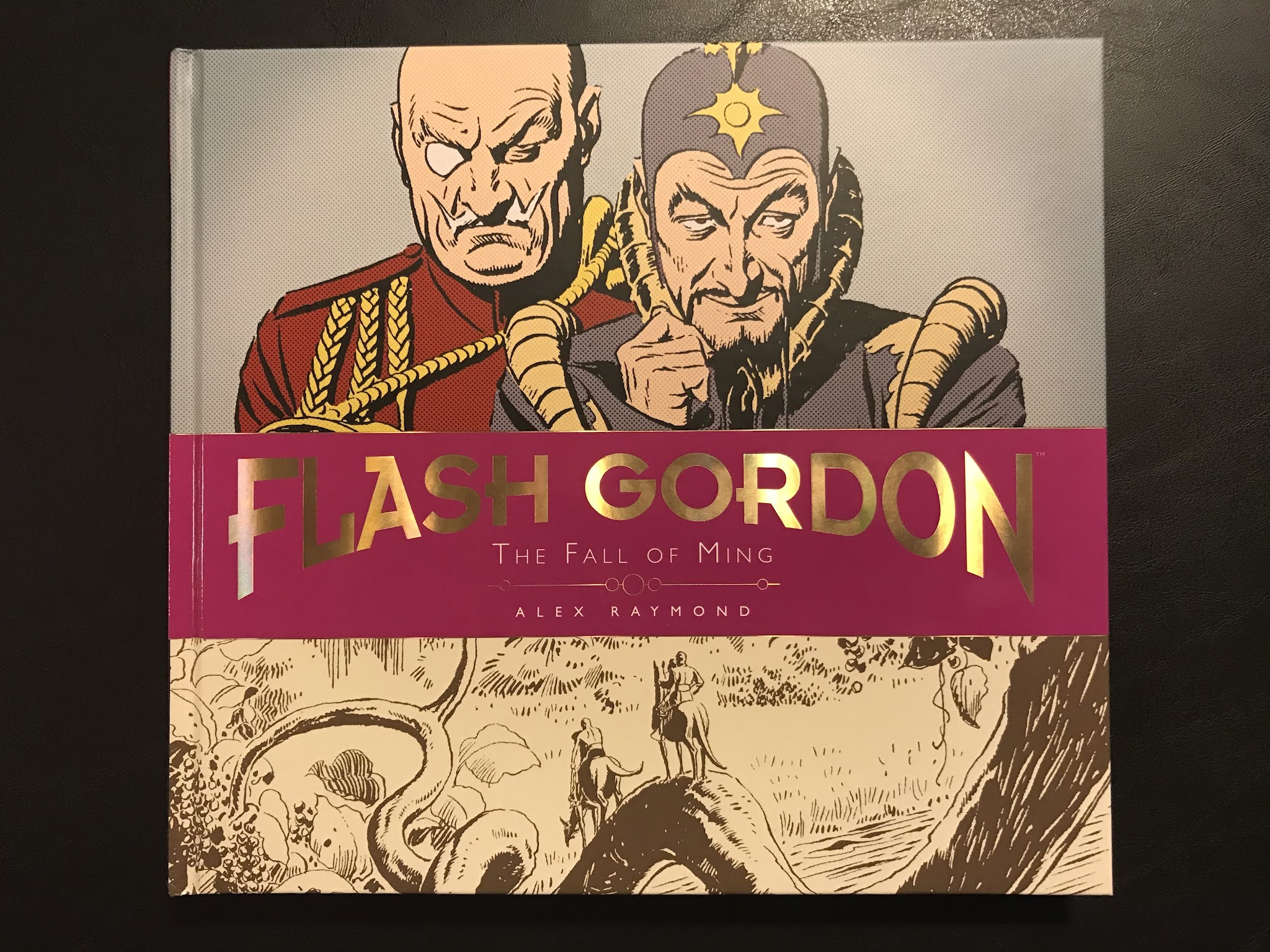
My copy of Flash Gordon: The Fall of Ming (Sundays 1941-1944). The cover depicts Warden Terro and Ming the Merciless.

Flash Gordon: The Fall of Ming (Sundays 1941–1944) is the third volume in the collected Flash Gordon comic strips by Alex Raymond and Don Moore, and the final volume containing Raymond's art. Raymond enlisted in the U.S. Marine Corps in 1944, and Austin Briggs, who was the artist of the Flash Gordon daily comic strips from 1940–1944, became the new artist of the Sunday comic strips immediately following Raymond's final strip, which was printed 7 May 1944. Later, upon his return from the war, Raymond devoted himself to another comic strip of his own creation, Rip Kirby.

SPOILER ALERT

The early 1940s mark a period of great change for this comic strip. We witness the fall of Emperor Ming and the establishment of a union of democratic republics on Mongo. Zarkov makes contact with Earth for the first time, and upon learning that the nations of Earth have been plunged into another great war, he, Flash, and Dale embark on a voyage home to do their part. We learn that Flash, too, is an inventor, and he lends his talents to the creation of new weapons based on the technology of Mongo to aid the war effort and, indeed, to thwart an invasion of the east coast of the United States. Aware that they need a greater supply of radium—that miracle element so popular in early 20th century science fiction—for these new weapons, and that Mongo has it in far greater abundance, Flash and company head back to Mongo... and promptly crash-land in a previously unexplored region of that planet, where they become embroiled in toppling another despot.

I admit to missing some of our old friends from Mongo: Thun, Barin, Aura, Vultan, and others, but in the last strip in this volume we see Flash and Dale (where is Zarkov?) heading to Mongo. I assume that "Mongo" in this case refers to the nation of Mongo, since they are already on the planet Mongo, but one can never tell. I would also like to assume that they haven't forgotten their reason for returning to Mongo, since it hasn't been mentioned since they left Earth, but again, one can never tell. Maybe they will bump into Zarkov and he can remind them.

END SPOILER ALERT

At first, I thought I might conclude my reading of Flash Gordon with Raymond's departure from the strip, but cliffhangers being what they are, I might have to read on. Meanwhile, from the first decade of the Sunday strips alone, I have compiled lists comprising 20 different peoples, 47 different creatures, and 121 different technological curiosities of the planet Mongo, all of which can be found in the Lists of Mongo.

21 September 2021

Flash Gordon Inspiration: The Third Movie Serial 1940

Movie poster of the 1940 Flash Gordon serial, Flash Gordon Conquers the Universe.

Four years after the first Flash Gordon serial and six years after the comic strip debut, Flash Gordon Conquers the Universe premiered in cinemas. The returning cast included Larry "Buster" Crabbe as Flash Gordon, Charles Middleton as Ming the Merciless, and Frank Shannon as Dr. Zarkov. In this final serial, several parts were recast, including Carol Hughes as Dale Arden, Roland Drew as Prince Barin, Shirley Deane as Princess Aura, and John Hamilton as Prof. Gordon.

Once again, no sooner have Flash, Dale, and Zarkov returned to Earth then they find reason to rocket off to Mongo, this time to stop the "Purple Death," an alien plague that threatens to wipe out all of humanity. Flash and friends find themselves embroiled in one difficulty after another as they deal with the machinations of Emperor Ming, Captain Torch (played by Don Rowan), and Lady Sonja the spy (played by Anne Gwynne).

There is something less elemental about this third serial that deprives it of some of the vigor of the first two. Part of it can certainly be attributed to the recasting of Dale and Aura, neither of whom have much of a personality beyond that of the standard starlet, although it should be noted some of the blame lies with the writers of their lines. Mongo seems just a little less fantastical than it did in 1936, but then, so did the comic strip by 1940. Fans will find it worth watching, but it doesn't quite match that first cinematic appearance of Flash.

Flash Gordon Conquers the Universe may not be the best of the Flash Gordon serials, but it's still better than most, and it can still provide many ideas for adventures (as well as serve as an example of cliffhanger pacing) for The Savage World of Flash Gordon and other swords & rocketry Savage Worlds.

Still from Flash Gordon Conquers the Universe depicting Dale Arden and Flash Gordon aboard a rocket ship.

13 September 2021

Flash Gordon Inspiration: The Comic Strips 1937-1941

My copy of Flash Gordon: The Tyrant of Mongo (Sundays 1937-1941). The cover depicts Dr. Hans Zarkov and Flash Gordon.

Flash Gordon: The Tyrant of Mongo (Sundays 1937–1941) is the second volume in the collected Flash Gordon comic strips by Alex Raymond and Don Moore. Some things changed and some things remained the same. In the span of time covered by this volume, the dialogue moved from balloons to borderless text with lines drawn to the speaker to standard literary dialogue with quotation marks and written indications of who spoke (e.g. "That scream!" says Flash, "It sounded like Dale!"). The skin color of the ruling people of Mongo (as well as the rebels of Arboria) continued to fluctuate, eventually settling on the same shade as Flash, Dale, and Dr. Zarkov by October 1938. Coloring varied in consistency from 1934–1938 as Alex Raymond was responsible for penciling and inking, but "the drawings were colored at the syndicate office." One notable mistake included giving Flash dark hair (4 August 1935).

The themes of mercy, forgiveness, jealousy, betrayal, freedom, and tolerance continued to be highlighted, with two unstated questions looming in the mind of the reader: Will Ming be toppled; and will Flash Gordon, Dale Arden, and Dr. Zarkov ever see Earth again?

I daresay the Flash Gordon comic strip steadily improved with every year as Raymond and Moore refined their styles. The frame count decreased, but the details in art and story increased. I read this volume much more rapidly than the first, and I suspect I'll finish the third sooner than I'd like, which is regrettable since it marks the end of Raymond's involvement.

06 September 2021

Flash Gordon Inspiration: The Second Movie Serial 1938

Movie poster of the 1938 Flash Gordon serial, Flash Gordon's trip to Mars.

Two years after the first Flash Gordon serial and four years after the debut of the comic strip, Flash Gordon's Trip to Mars appeared in cinemas. Returning cast included Larry "Buster" Crabbe as Flash Gordon, Jean Rogers as Dale Arden (now a brunette), Frank Shannon as Dr. Zarkov, Charles Middleton as the Emperor Ming, and Richard Alexander as Barin. Other major cast included Beatrice Roberts as Queen Azura, C. Montague Shaw as the King of the Clay People, and Donald Kerr as "Happy" Hapgood (the comic relief).

No sooner do Flash, Dale, and Zarkov return to Earth after saving it from the evil machinations of Ming the Merciless than they are confronted with another threat to Earth's safety. A strange beam from space is destroying the Earth's atmosphere, so the trio (plus a stowaway reporter known as "Happy") immediately set off in a rocket ship to investigate its source and stop it. This leads them to the planet Mars, where its most powerful ruler, the magic-wielding Queen Azura, has allied herself with Ming who somehow survived his peril in the last chapter of the previous serial.

The serial takes great liberties with the source material (such as placing Azura's kingdom on Mars instead of Mongo), but it retains the spirit of both the comic strip and the first serial. Like both, it is a valuable if not essential point of reference for running or playing The Savage World of Flash Gordon for Savage Worlds.

Still from Flash Gordon's Trip to Mars depicting Dr. Zarkov, Happy Hapgood, Dale Arden, and Flash Gordon before leaving Earth.
Still from Flash Gordon's Trip to Mars depicting Flash Gordon, Dale Arden, Dr. Zarkov, and Happy Hapgood on Mars.

20 June 2021

Flash Gordon Inspiration: The First Movie Serial 1936

Movie poster of the 1936 Flash Gordon serial.

Two years after the debut of the comic strip, Flash Gordon burst onto the silver screen as a serial starring Larry "Buster" Crabbe, Charles Middleton, Frank Shannon, and Jean Rogers. As an adaptation it took certain liberties owing to the usual constraints, but it was largely faithful to the source. The PBS show Matinee at the Bijou probably introduced me to the serials, and even though I had seen Star Wars several years earlier, I was nonetheless enraptured by the 1936 spectacle of Flash Gordon's adventures on Mongo.

Today's viewers may find humor where none was intended, and this can be part of the fun of watching it now, but there is much to glean in the serials for those who are running or playing The Savage World of Flash Gordon in terms of pacing, role-playing, and capturing the atmosphere of the setting.

I recently started watching the first serial again, and I can state honestly that I notice more and enjoy it more upon every viewing. I own it on DVD, of course, but I believe it is also available on certain streaming channels. I have also been listening to the Space Soldiers Podcast, which provides a commentary on each episode of the various Flash Gordon serials. These can be played synchronously in MST3K or RiffTrax fashion, but I prefer to listen to them separately.

Flash Gordon the serial from 1936 is still an excellent source of inspiration for one's Savage Worlds games.

N.B. The first Flash Gordon serial is also known as Flash Gordon: Space Soldiers, a later re-titling meant to prevent it from being confused with the 1950s Flash Gordon television show.

A photographic portrait of Buster Crabbe as Flash Gordon and Jean Rogers as Dale Arden.

16 May 2021

Flash Gordon Inspiration: The Comic Strips 1934-1937

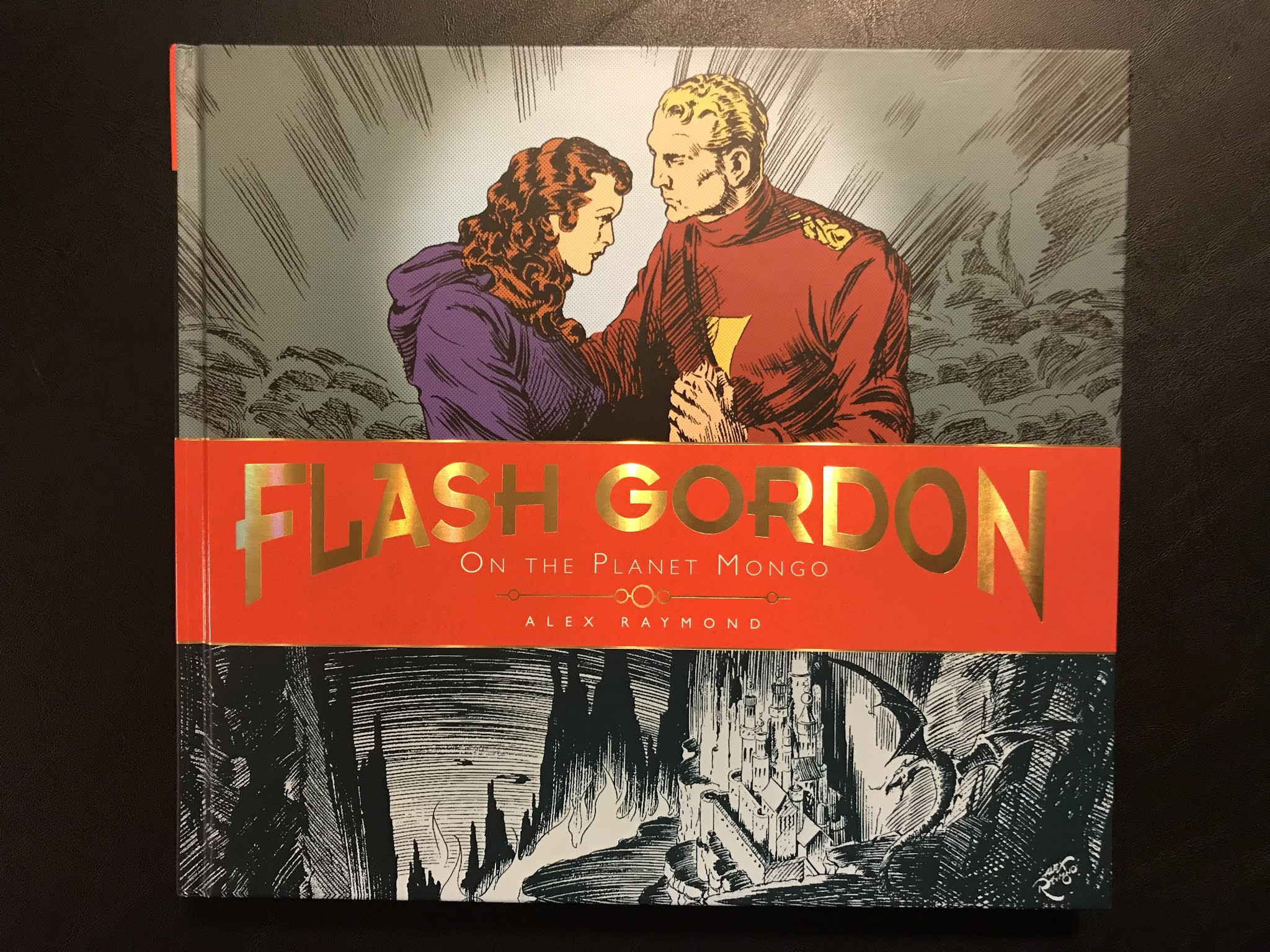
My copy of Flash Gordon: On the Planet Mongo (Sundays 1934-1937). The cover depicts Dale Arden and Flash Gordon.

I first came to appreciate Flash Gordon as a fan of the movie serials starring Larry "Buster" Crabbe and the animated television series by Filmation, but even as an elementary school student, I was well aware that it all began with a comic strip in the 1930s. Created by artist Alex Raymond and ghostwriter Don Moore, it is considered one of the greatest strips in the history of the medium, and its influence on the genre of science fiction adventure is staggering.

To understand the full scope of Flash Gordon—and to appreciate the accuracy or inaccuracy of its various adaptations—one needs to go to the source, so I purchased Flash Gordon: On the Planet Mongo (Sundays 1934–1937) and two other volumes spanning the entirety of Alex Raymond's Sunday strips.

I am not even halfway through this volume and will forgo giving a review (other than to state I am very satisfied), but I thought I would share a few initial observations about the earliest strips.

  • Ming is always referred to as "Ming, the Merciless" with a comma after "Ming."
  • Flash Gordon's usual exclamations of surprise are "Great Scott," "Great guns," and "Good heavens."
  • Dale's surname changes from "Arden" to "Ardan" and back again.
  • Mongo is variously referred to as a "strange new planet," a "comet," and back to "planet."
  • Zarkov's original plan was a suicide mission: deflect the course of the runaway planet/comet that was heading to Earth by flying a rocket into it. The fact that it was instead pulled into Mongo's gravity and forced to crash-land was (somehow) unanticipated.

Reading the Sunday strips is enormously entertaining, and it is renewing my appreciation for the serial, the animated television show, and the 1980 film.

GORDON'S ALIVE

30 January 2021

Flash Gordon Inspiration: Coloring and Activity Book

Adventures of Flash Gordon Coloring and Activity Book from 1979.

This is the cover of the Adventures of Flash Gordon Coloring and Activity Book, published in 1979, the same year as the Flash Gordon animated television series. I can't remember if my first exposure to Flash Gordon was the animated series or the film serials starring Buster Crabbe (which I probably watched on Matinee at the Bijou on PBS), but I was a big fan of both. Later, I was equally a fan of the original comic strip and the 1980 film starring Sam Jones. Last year, I bought the The Savage World of Flash Gordon for Savage Worlds, and with any luck I'll be running it for my players this year.

In the meantime, I'll be sharing thoughts and occasional images related to Flash Gordon's universe, such as this coloring book I acquired when I was ten years old and somehow managed to preserve into the 21st century. Being a children's coloring book, it isn't challenging, but perhaps someday its contents will inspire an adventure. (I'd scan it in its entirety, but I'm concerned the process might damage it.)

[Edit: This was originally entitled "Flash Gordon Inspiration 1," but I have since decided to differientiate the articles in this series by subject.]

Pondering New List Projects

I am pondering a new list project for Savage Arts & Sciences , which will require me to watch all three Flash Gordon movie serials ye...